Wednesday, March 13, 2013

Raspberry Pi has a New Camera


 The Raspberry Pi Foundation has declared last February that they will be implementing a new camera module for their minicomputer.
They will add more components and elements for their product once the launching of their camera becomes successful.
The Foundation will also give away ten pre-production camera modules to deserving enthusiast and designers. They will get to try it  before April’s release and check out the cameras compatibility to new and  existing projects that requires video they have created.So make sure to think thing useful and creative if you want to avail one.
“We want you to try to get the camera doing something imaginative,” said the Foundation in a blog post.
One of the reasons is to make sure the camera works well together with its software when its goes on sales in stores in April.So get ready with your proposal and contact them at iwantacamera@raspberrypi.org. Make sure to impress them with your creative ideas for a project.They will also need your mailing address once you win and entries should be received on or  before March 12.

Wednesday, February 27, 2013

Voice Control Garage Door using Raspberry Pi

What a convenience it would be if you can open up your garage door with your smart phone by voice command. A designer named Christopher has done just like that by linking his Android phone and his raspberry pi.

He goes further by installing fail safe proximity switch to determine if the door is already open or closed to prevent misfiring.He further added another protection for his design by  the installation of opto-isolators to protect the circuit from external electricity coming from lightning and short circuit.


For complete details of the design check it out here!

Related Links:


Raspberry Pi Helps create Digital Beer Board Keg


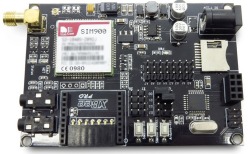
GSM Arduino Going To The Cloud

GSM Arduino will now be available in the cloud. Cumulocity will be hosting Arduino with GSM module for mobile in the Embedded World Conference in Nuremberg. 

All those who are interested will just sign up for the free version but for those who cannot resist the upgrade version then a €2.50 monthly fee that will provide 400 MB of storage.

Wednesday, February 20, 2013

Automatically Lower the Volume During Loud Commercials with an Arduino


Ever notice how much louder commercials are than the actual program you're watching? Every time a break hits, it's like they're yelling at you about buying their product. Instructables usertechbitar shows us how to fix the problem with a little DIY project.
Basically, you place this little device next to your TV and it monitors the volume. When it detects your TV going over a preset threshold, it will send the "volume down" signal to your TV. You'll need an Arduino and some small miscellaneous electronics parts to make it happen, and if you're familiar with building on the Arduino (which we've talked about before), it shouldn't be too difficult. Check out the video above to see the loudness guard in action, or hit the link below for the full step-by-step instructions.

Arduino-controlled pelvic-floor strength-tester, with light-up penis

Last September, Doctor Kristen Stubbs -- a roboticist who makes sex-gadgets for her Toymaker Project -- released a video (NSFW) demonstrating her prototype pelvic-floor strength-tester, called "The Hammer." The Hammer has a bulb that is internally inserted, containing a squeeze-sensor, and a penis-shaped, light-up readout that protrudes between the wearer's legs. The harder the wearer squeezes, the more the readout lights up.

http://boingboing.net/2013/02/13/arduino-controlled-pelvic-floo.html

Tongueduino: How Arduino and tongues can help the blind see


When one of the senses is lost, an extremely effective coping mechanism involves hijacking other senses to fill the same role. Usually, hearing and touch are used in place of sight, but an MIT researcher named Gershon Dublon is using the tongue as a way to convey spatial and directional data to the blind. Dublon’s own tongue has been the testbed up until recently, but now the project is progressing to the point where 12 subjects will be using this Arudino-based tool to navigate.
Dubbed “Tongueduino,” this small Arduino system uses a grid of electrodes attached to the tongue to express various forms of input. In the video below, whisker analogs are shown as one method of converting tactile feedback into the system. When attached to magnetic sensors, it could even use the magnetic field of the earth and objects around the subject to convey information about direction and obstacles.

ArduSat – An Arduino based satellite

For a long time, the space exploration has been the domain of governments .. and not all governments, but only the strong governments. Now, Arduino is playing big and launching open source experiments .. in space !

http://www.openimpulse.com/blog/2013/02/ardusat-an-arduino-based-satellite/#more-1363